

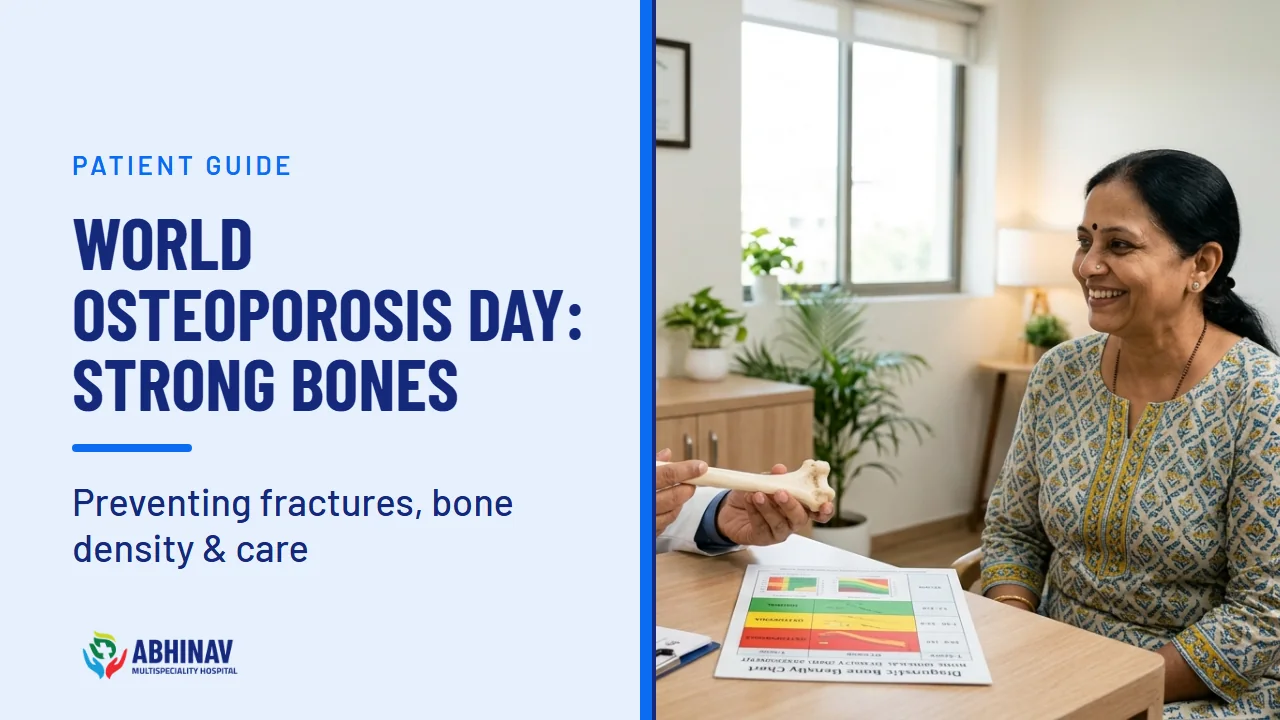
Every year on 20 October, World Osteoporosis Day is observed globally to shine a spotlight on bone health and highlight the hidden danger of osteoporosis. Often referred to by doctors as the “silent thief” or “silent epidemic,” osteoporosis gradually leaches mineral density and strength from bones without causing pain or visible symptoms—until a minor trip, cough, or bump results in a sudden fracture.
In India, osteoporosis and its precursor, osteopenia, are remarkably widespread. Studies estimate that more than 50 million people in India live with low bone mineral density, with postmenopausal women and seniors over 60 being at highest risk. Because bones weaken quietly, millions discover they have osteoporosis only after fracturing a hip, wrist, or vertebra. On World Osteoporosis Day, understanding how to safeguard your bone mass, when to get tested, and how modern medical care protects bone health can keep you active and independent for life.
What is osteoporosis and how does it develop?
Living bone is dynamic tissue that is constantly broken down and rebuilt in a natural cycle called bone remodeling. In your teens and twenties, your body builds new bone faster than it breaks old bone down, reaching peak bone mass around age 30.
After age 35 to 40, bone resorption slowly outpaces bone formation. In healthy individuals with good nutrition and active lifestyles, this loss occurs gradually. However, in osteoporosis:
- The microscopic honeycomb structure inside the bone becomes thin, brittle, and porous.
- The outer cortex of the bone thins down.
- Even minimal trauma—such as bending over to lift a bucket, missing a step, or slipping on a wet bathroom tile—can cause a severe bone break (known as a fragility fracture).
Why are Indian women particularly vulnerable?
While men can certainly develop osteoporosis in their seventies, women face a significantly higher risk due to biological and nutritional factors:
- Estrogen drop during menopause: Estrogen is the hormone that protects bone mineral density. In the first 5 to 7 years following menopause, women can lose up to 20% of their total bone mass.
- Dietary calcium shortfall: Traditional Indian diets frequently fall short of the recommended 1,000 to 1,200 mg daily calcium requirement, particularly when dairy intake is low.
- Widespread Vitamin D deficiency: Despite abundant sunlight, over 70% of urban Indians have low vitamin D levels due to indoor routines, skin pigmentation, and limited sun exposure during peak UV-B hours (11:00 AM to 2:00 PM).
- Smaller peak bone reserve: Indian women genetically tend to have smaller bone frames compared to Western populations, leaving less bone reserve as aging accelerates.
The three most common fracture sites
| Fracture Site | Typical Trigger | Impact on Daily Life |
|---|---|---|
| Hip (Femoral neck) | Slip or fall at home | Requires immediate surgery or joint replacement; carries risk of prolonged immobility in seniors. |
| Spine (Vertebral compression) | Bending forward, lifting weights, severe cough | Causes gradual loss of height, stooped posture (“dowager’s hump”), and chronic mid-to-lower back pain. |
| Wrist (Colles’ fracture) | Outstretched hand during a forward slip | Sudden deformity, severe wrist swelling, requires plaster casting or surgical pinning. |
How is osteoporosis diagnosed? Understanding the DEXA scan
Standard X-rays only show bone loss after more than 30% to 40% of bone mass has already vanished. The gold standard for early, accurate detection is a DEXA Scan (Dual-Energy X-ray Absorptiometry).
A DEXA scan is a painless, low-radiation test that takes about 10 to 15 minutes to measure bone mineral density at the hip and lumbar spine. It calculates a T-score by comparing your bone density to that of a healthy 30-year-old adult:
- T-score -1.0 or higher: Normal bone density.
- T-score between -1.0 and -2.5: Osteopenia (low bone mass; early warning stage).
- T-score -2.5 or lower: Osteoporosis (high risk of fragility fractures; medical intervention required).
In addition to DEXA, doctors recommend checking blood levels of Serum Calcium, Vitamin D3, Alkaline Phosphatase, and Thyroid function to rule out secondary causes of accelerated bone thinning.
Five pillars of bone health and fracture prevention
Preventing osteoporosis is a lifelong commitment, but even if bone thinning has already started, medical management can stop further loss and significantly reduce fracture risk:
- 1. Optimize calcium intake: Aim for 1,000 mg to 1,200 mg of calcium daily through dairy (milk, paneer, curd), ragi (finger millet), sesame seeds (til), green leafy vegetables, and fortified foods. When diet alone is insufficient, your doctor can prescribe calcium supplements.
- 2. Correct Vitamin D levels: Calcium cannot be absorbed from the gut without adequate Vitamin D. Safe sun exposure and medical-grade Vitamin D3 supplementation (prescribed under doctor guidance) restore healthy absorption.
- 3. Engage in weight-bearing & resistance exercise: Bones grow stronger under mechanical load. Brisk walking, climbing stairs, light dumbbell exercises, and yoga stimulate bone-forming cells (osteoblasts). Avoid sudden twisting or deep forward spinal bends if diagnosed with osteoporosis.
- 4. Fall-proof your home for elders: Most hip fractures occur indoors. Ensure skid-free bathroom tiles, install sturdy grab bars beside toilets, keep night lights on in corridors, remove loose floor rugs, and verify vision prescriptions regularly.
- 5. Prescription bone-strengthening medications: For patients with established osteoporosis, orthopaedic doctors prescribe targeted medications such as bisphosphonates (which slow bone breakdown) or anabolic agents like teriparatide (which stimulate new bone formation). Never take these medications without a specialist’s prescription and monitoring.
Bone health & orthopaedic care at Abhinav Hospital, Nagpur
At Abhinav Multispeciality Hospital in Lashkari Bagh, Nagpur, our Orthopaedics and Fracture Care Department provides end-to-end bone health services for individuals and seniors:
- Comprehensive Orthopaedic Consultations: Led by Dr. Abhinav Bhatnagar (Consultant Orthopedic Surgeon, specialist in joint replacement, complex trauma, and geriatric bone health), who evaluates osteoporosis risk, previous fractures, and personalized bone-strengthening regimens.
- In-House Diagnostic Pathology: Rapid testing for Vitamin D3, Serum Calcium, phosphorus, and bone metabolic markers in our accredited diagnostic lab.
- Advanced Fracture & Trauma Surgery: If a fracture occurs, our modular operation theatres equipped with C-Arm fluoroscopy allow precision fixation, minimally invasive plating, and joint replacement surgery for hip fractures.
- Dedicated Physiotherapy & Rehabilitation: Guided balance and strengthening programmes under expert physiotherapists to prevent falls and regain mobility safely.
- Cashless Insurance Support: Direct cashless claim settlement available with 34 health insurance companies and TPAs.
To consult an orthopaedic specialist or check your bone health, visit Abhinav Multispeciality Hospital at 10 No. Puliya, Lashkari Bagh, Nagpur, or call our reception team at +91 75571 60334.
Sources
- International Osteoporosis Foundation (IOF): World Osteoporosis Day global initiative and clinical guidelines
- Indian Council of Medical Research (ICMR): Guidelines on bone health, calcium, and Vitamin D in Indian populations
- American Academy of Orthopaedic Surgeons (AAOS): Osteoporosis overview, symptoms and prevention
- National Institute of Arthritis and Musculoskeletal and Skin Diseases (NIAMS): Bone mineral density tests and treatments