

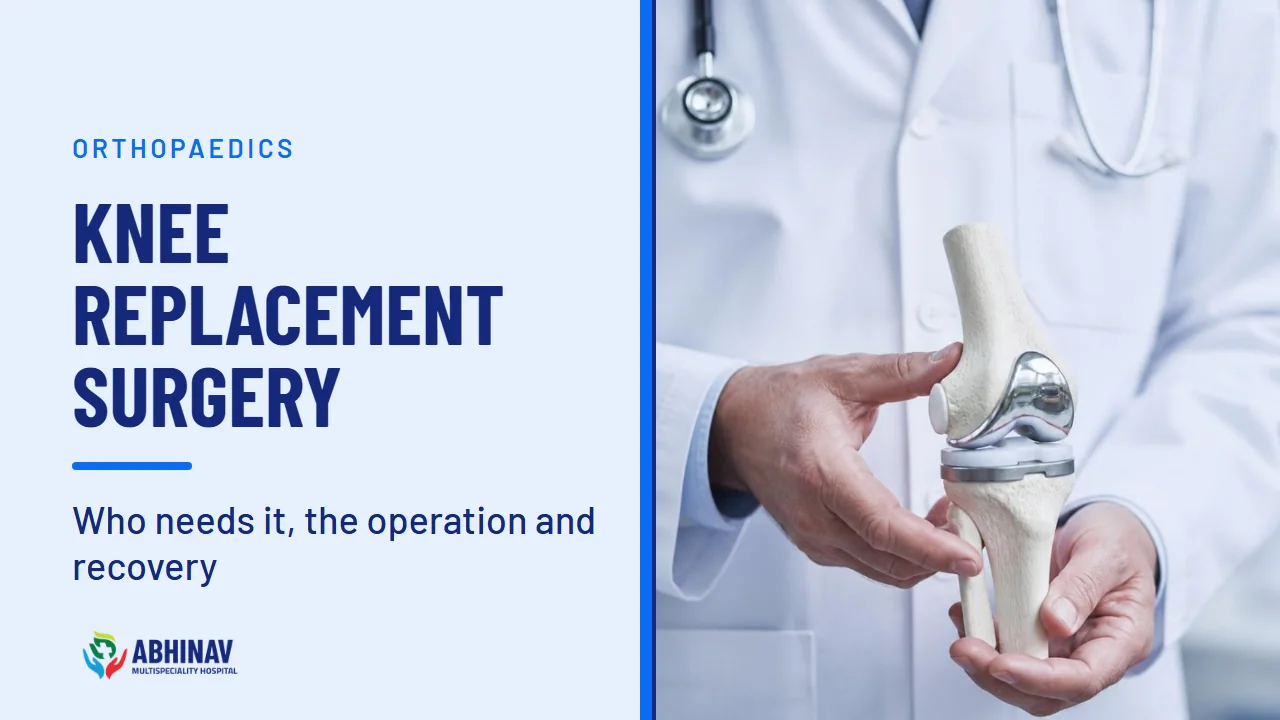

A knee replacement (also called total knee arthroplasty) is an operation that removes the damaged surfaces of a worn-out knee and replaces them with a smooth artificial joint made of metal and medical-grade plastic. It is one of the most common and most successful operations in orthopaedics, and for most people it takes away the grinding pain of arthritis.
This guide explains who needs one, what to try first, how the operation is done, what recovery looks like week by week, and what decides the cost in Nagpur.
Who needs a knee replacement?
Most knee replacements are done for osteoarthritis, the wear of the cartilage that cushions the knee. Rheumatoid arthritis and old injuries to the knee can cause the same damage. Your orthopaedic surgeon may suggest a replacement when:
- knee pain stops you walking more than a short distance, climbing stairs or getting up from a chair;
- the pain wakes you at night or is there even when you rest;
- the knee is stiff, swollen or has started to bend outwards (bow legs) or inwards (knock knees);
- medicines, physiotherapy, weight loss and injections have not helped enough after several months;
- X-rays show that the cartilage is badly worn, with bone rubbing on bone.
Age alone does not decide it. Most people who have a knee replacement are between 60 and 80, but the decision rests on how much the knee limits your life and what the X-ray shows.
What can you try before surgery?
Surgery is not the first step. Many people with knee arthritis manage well for years with:
- Exercise and physiotherapy to strengthen the thigh muscles (quadriceps), which take load off the knee. Our physiotherapy team can set a programme you can do at home.
- Weight control: every extra kilogram of body weight adds several kilograms of force on the knee with each step.
- Pain medicines for short periods, taken as your doctor advises, especially if you have diabetes, kidney disease or stomach problems.
- Injections into the knee, which can ease a flare of pain for a few weeks or months.
- Walking aids and footwear: a walking stick held in the hand opposite the painful knee, and soft, cushioned shoes.
Total or partial knee replacement?
In a total knee replacement, all three surfaces of the joint are resurfaced: the end of the thigh bone, the top of the shin bone and, in some patients, the back of the kneecap. This is the most common type.
In a partial (unicompartmental) knee replacement, only the worn part of the knee is replaced. It suits a smaller group of patients whose arthritis is limited to one side of the knee and whose ligaments are healthy. Your surgeon decides which is right after examining you and studying your X-rays.
How is the operation done?
The operation usually takes one to two hours. Most patients have spinal anaesthesia, an injection in the back that numbs the legs, often with medicine to make you sleepy; some have a general anaesthetic.
The surgeon makes a cut over the front of the knee, removes the damaged cartilage and a thin layer of bone, and fits the metal parts to the thigh and shin bones, usually fixed with bone cement. A plastic spacer between them lets the new joint glide smoothly.
Before the operation you will have blood tests, an ECG and sometimes a chest X-ray, and the team will check your sugar, blood pressure and any medicines, such as blood thinners, that need to be paused.
What does recovery look like?
Recovery starts the same day or the next. A physiotherapist helps you stand and walk with a walker, because early movement speeds recovery and lowers the risk of blood clots.
| When | What to expect |
|---|---|
| Day of surgery or next day | Standing and a few steps with a walker, with the physiotherapist |
| First few days | Walking to the toilet, bending the knee, a few stairs; you go home when you can do these safely |
| About 2 weeks | Wound check; stitches or clips removed |
| 4 to 6 weeks | Moving from a walker to a walking stick; most light household tasks |
| 6 to 8 weeks | Driving again for many people, once you can bend the knee and brake safely; ask your surgeon first |
| About 3 months | Most pain and swelling settled; walking without support |
| Up to 1 year | Swelling settles fully and strength keeps improving |
The exercises you do at home in the first three months matter as much as the operation. Doing them every day is what gives you a knee that bends and straightens well.
Many surgeons advise against deep squatting and sitting cross-legged on the floor after a knee replacement, and suggest a western-style toilet at home. Ask your surgeon what your new knee will allow.
What are the risks?
Knee replacement is a safe operation, but like any surgery it carries some risks:
- Infection of the wound or the joint, which is uncommon and is prevented with antibiotics and careful wound care;
- Blood clots in the leg veins, prevented with early walking, leg exercises and blood-thinning medicine;
- Stiffness, if the knee is not exercised enough in the first weeks;
- Ongoing pain in a small number of patients;
- Wear or loosening of the parts after many years, which may need a second operation.
Tell your doctor straight away if the wound becomes red, hot or starts to leak, if you get a fever, or if your calf becomes painful and swollen or you feel short of breath.
How long does a knee replacement last?
Most modern knee replacements last 15 to 20 years or more. How long yours lasts depends on your weight, how active you are, and how well the joint was positioned. Keeping your weight down and avoiding high-impact sports such as running and jumping help it last longer.
What does knee replacement cost in Nagpur?
There is no single price, because the cost depends on:
- whether one knee or both knees are replaced;
- the type and brand of implant;
- the room you choose and how many days you stay;
- your other health conditions and the tests they need;
- physiotherapy after surgery.
Ask for a written estimate after your consultation, once the surgeon knows what your knee needs. Most health insurance policies cover knee replacement for arthritis, though many have a waiting period for joint replacement, so check your policy. Abhinav Hospital offers cashless treatment with 34 insurance companies and TPAs.
Knee replacement at Abhinav Hospital, Nagpur
Dr. Abhinav Bhatnagar, consultant orthopaedic surgeon, performs knee, hip and shoulder replacement and treats sports injuries and fractures at Abhinav Multispeciality Hospital in Lashkari Bagh. He sees patients Monday to Saturday.
At your first visit, bring any knee X-rays or MRI reports, a list of the medicines you take, and your insurance card. He will examine the knee, explain whether you need surgery or can manage with other treatment, and plan the next steps with you. See the Orthopaedics department for more.
Sources
- American Academy of Orthopaedic Surgeons, OrthoInfo: Total knee replacement
- American Academy of Orthopaedic Surgeons, OrthoInfo: Arthritis of the knee
- NHS: Knee replacement