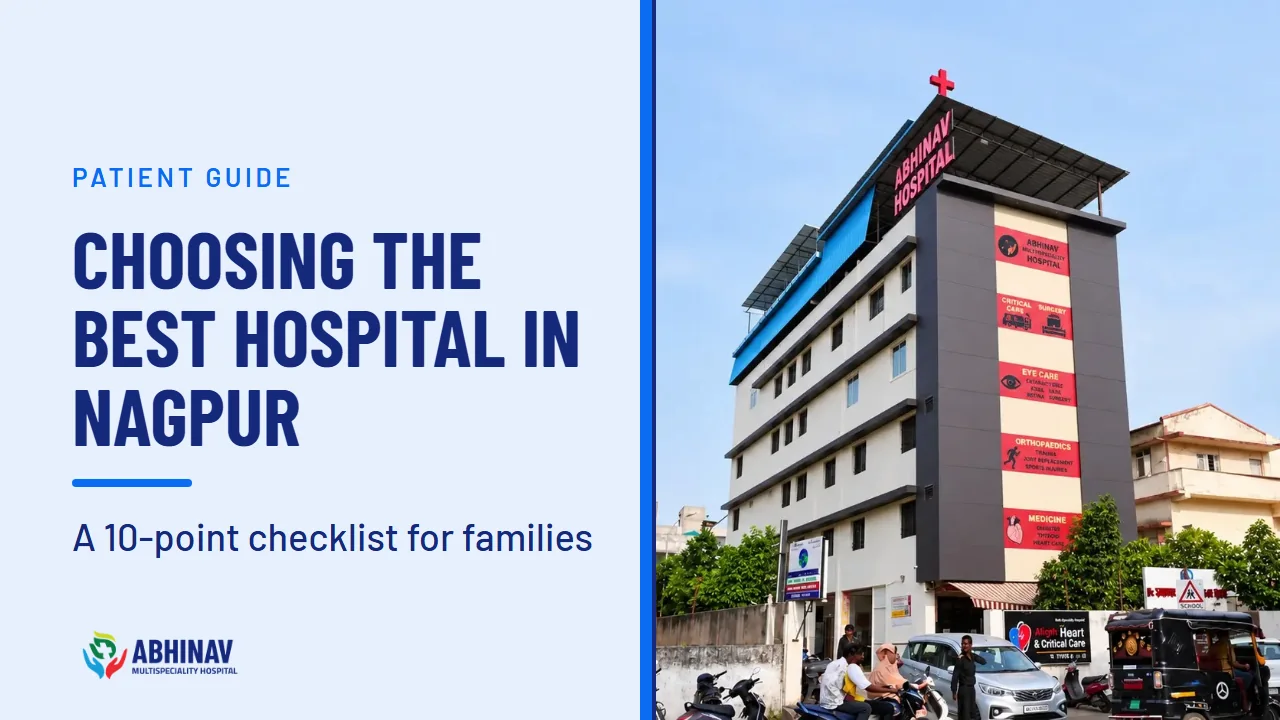
The best hospital for your family is the one that can treat your problem safely, that you can reach quickly in an emergency, and that is open with you about care and costs. Size and fame matter less than people think. This checklist covers the ten things worth checking before you choose a hospital in Nagpur, whether for a planned operation or for the day something goes wrong.
1. Is the hospital NABH accredited?
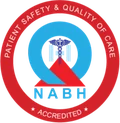
NABH, the National Accreditation Board for Hospitals & Healthcare Providers, checks hospitals against national standards for patient safety, infection control, medicine handling and record keeping, and inspects them again to renew the accreditation. It is the clearest single sign that a hospital follows set processes rather than habits. You can check any hospital on NABH’s list of accredited organisations.
2. Is the emergency department open 24 hours?
Ask whether a doctor is on duty in casualty day and night, not just on call, and whether the hospital can arrange an ambulance. Save the emergency number in your phone before you need it.
3. Is there an ICU with a critical care team?
Serious infections such as dengue, heart attacks, strokes and major operations can need intensive care at short notice. A hospital with its own ICU and an intensivist can treat a patient whose condition changes overnight without moving them elsewhere.
4. Are the specialists you need available, and when?
Look up the doctors who treat your condition: their qualifications, years of experience and OPD timings. Every doctor practising in India must be registered with a medical council, and you can check a registration on the National Medical Commission’s Indian Medical Register.
5. Are tests done under one roof?
A pathology lab, X-ray, ECG and ultrasound in the same building save hours of travel and let doctors act on results the same day. For a heart patient, ask about TMT and echocardiography too.
6. Is your insurance accepted for cashless treatment?
Check that the hospital is empanelled with your insurance company or TPA before a planned admission. Cashless treatment means the insurer pays the hospital directly, and you pay only what your policy does not cover.
7. How quickly can you get there?
In a heart attack, stroke or serious injury, the first hour matters most. A well-equipped hospital twenty minutes away can be a better choice than a famous one across the city in traffic. Know your nearest good hospital, and the route.
8. What do patients say?
Read the Google reviews, especially recent ones, and look at the number of reviews as well as the rating. A high rating from hundreds of patients means more than a perfect score from a handful. See how the hospital replies to complaints.
9. Is the billing clear?
A good hospital gives you a written estimate before a planned admission, explains package rates and what they include, and tells you which items insurance will not cover. Ask before you agree, not at discharge.
10. How are you treated on the first call?
Notice whether the front desk answers your questions clearly, whether the wards and toilets are clean, and whether staff wash their hands or use sanitiser between patients. Small things show how a hospital is run.
A quick checklist
| Check | Where to find it |
|---|---|
| NABH accreditation | NABH’s list of accredited organisations, and the hospital’s website |
| 24-hour emergency and ambulance | Call the emergency number and ask |
| ICU and critical care team | The hospital’s facilities and doctors pages |
| Specialists and OPD timings | Doctor profiles; the Indian Medical Register for registration |
| Lab, X-ray, ECG, ultrasound | Facilities list, or ask at reception |
| Cashless insurance | The hospital’s insurance and TPA list |
| Travel time | Google Maps at the time you would travel |
| Patient reviews | Google reviews: rating, number and how recent |
| Clear billing | Ask for a written estimate |
Is the biggest hospital always the best choice?
Not always. Large tertiary centres are the right place for transplants, complex cancer care and some rare operations. For most needs, such as fevers and infections, diabetes and blood pressure, fractures, joint replacement, cataract, hernia and gallbladder surgery, a well-run multispeciality hospital often means shorter waits, the same doctor at every visit and lower costs. A good hospital also tells you honestly when you need a bigger centre, and helps arrange the referral.
How Abhinav Multispeciality Hospital measures up
Abhinav Multispeciality Hospital has cared for patients in Lashkari Bagh, North Nagpur, since 1994. Against the checklist above:
- NABH accredited.
- 24-hour emergency department, with an ICU and a critical care team.
- 17 specialities, from general medicine, orthopaedics and eye care to cardiology, neurology, ENT and urology. See all doctors and their OPD timings.
- Tests under one roof: pathology lab, X-ray, ECG, ultrasound and computerised TMT, with modular operation theatres and a pharmacy.
- Cashless treatment with 34 insurance companies and TPAs.
- Rated 4.7 out of 5 on Google by more than 700 patients (October 2026).
Call, message on WhatsApp or visit us at 10 No. Puliya, opposite Swastik School, Lashkari Bagh, Nagpur.
Sources
- National Accreditation Board for Hospitals & Healthcare Providers: NABH and find an accredited organisation
- National Medical Commission: Indian Medical Register